
Justice
Meanwhile in Transnistria: Woman cited by the police for posting anti-Shevchuk messages

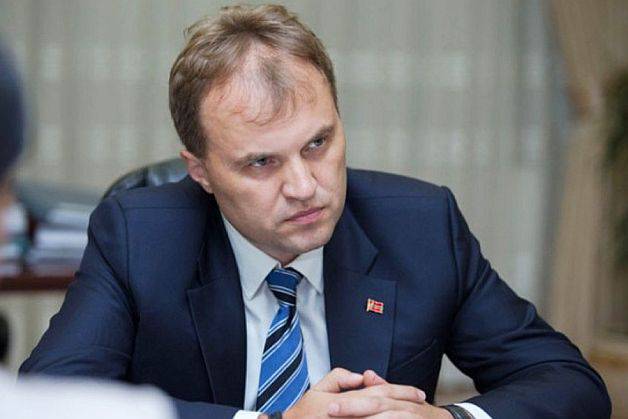
The persecution of free speech continues in the break-away region of Moldova, Transnistria.
On July 11th, Olga Ievleva, a children psychologist from Dubăsari town, was retained by the separatist militia and transported to the Department of Internal Affairs from Tiraspol for hearings. Ievleva was asked about her posts directed against the leader of the region Evgeny Shevchuk, as KGB (the local security committee) opened a case in April 2016. According to the so-called officers, the posts of Ievleva affected the leader who, “due to critics, couldn’t do his job”.
After one hour of hearings, Ievleva was informed that the next round of interrogations will take place in September 2016. She might be punished with a fee or with unpaid community service from 6 months to one year.
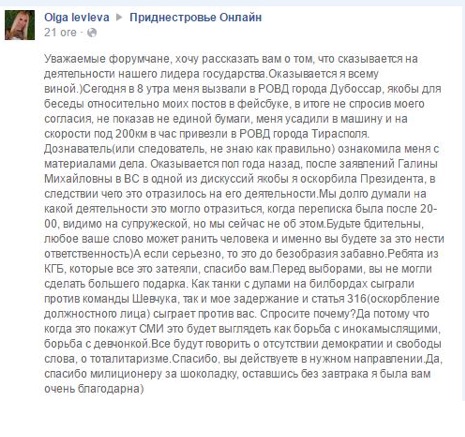
Olga thinks the actions of the militia and the allegations are abusive.
Recently, the Supreme Soviet, the local legislative body, adopted a law which introduced penal liability for denying the positive role of the Russian peace-keepers from Transnistria.


Politics
Promo-LEX about Maia Sandu’s UN speech: The president must insist on appointing a rapporteur to monitor the situation of human rights in Transnistria

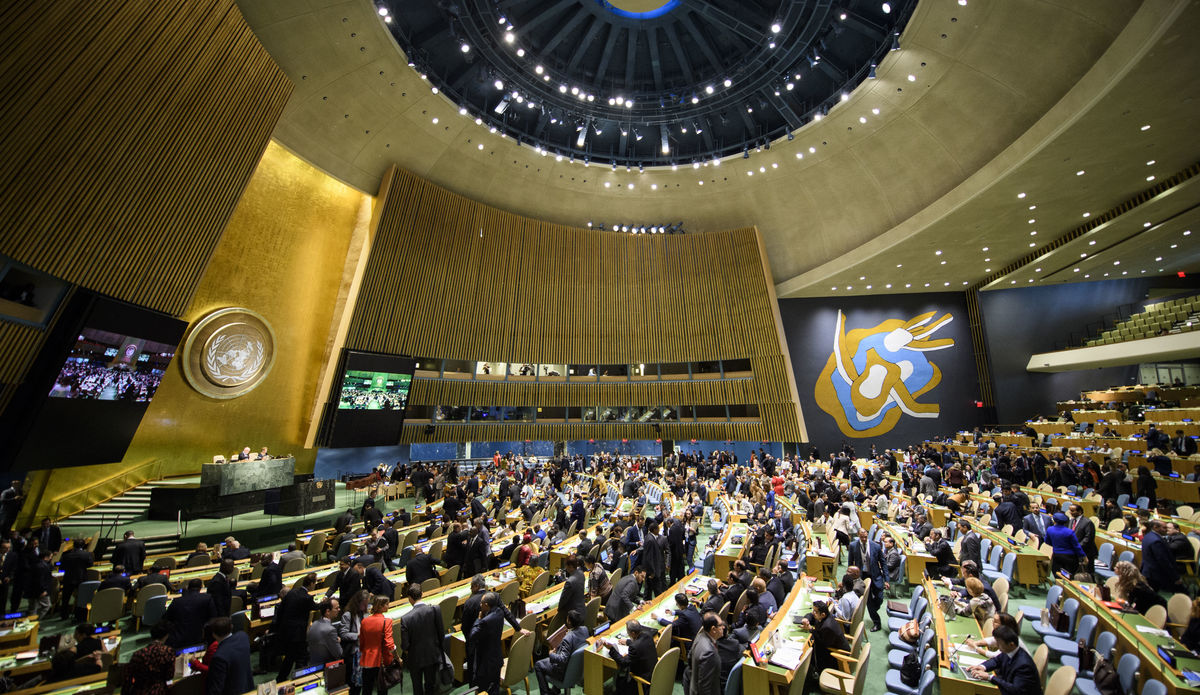
The President of the Republic of Moldova, Maia Sandu, pays an official visit to New York, USA, between September 21-22. There, she participates in the work of the United Nations General Assembly. According to a press release of the President’s Office, the official will deliver a speech at the tribune of the United Nations.
In this context, the Promo-LEX Association suggested the president to request the appointment of a special rapporteur in order to monitor the situation of human rights in the Transnistrian region. According to Promo-LEX, the responsibility for human rights violations in the Transnistrian region arises as a result of the Russian Federation’s military, economic and political control over the Tiraspol regime.
“We consider it imperative to insist on the observance of the international commitments assumed by the Russian Federation regarding the withdrawal of the armed forces and ammunition from the territory of the country,” the representatives of Promo-LEX stated. They consider the speech before the UN an opportunity “to demand the observance of the Universal Declaration of Human Rights by the Russian Federation with reference to this territory which is in its full control.”
“It is important to remember about the numerous cases of murder, torture, ill-treatment, forced enlistment in illegal military structures, the application of pseudo-justice in the Transnistrian region, all carried out under the tacit agreement of the Russian Federation. These findings stem from dozens of rulings and decisions issued by the European Court of Human Rights, which found that Russia is responsible for human rights violations in the region.”
The association representatives expressed their hope that the president of the country would give priority to issues related to the human rights situation in the Transnistrian region and would call on relevant international actors to contribute to guaranteeing fundamental human rights and freedoms throughout Moldova.
They asked Maia Sandu to insist on the observance of the obligation to evacuate the ammunition and the military units of the Russian Federation from the territory of the Republic of Moldova, to publicly support the need for the Russian Federation to implement the ECtHR rulings on human rights violations in the Transnistrian region, and to request the appointment of an UN Human Rights Council special rapporteur to monitor the human rights situation in the Transnistrian region of the Republic of Moldova.
**
The Promo-LEX Association concluded that 14 out of 25 actions planned within the National Action Plan for the years 2018–2022 concerning respecting human rights in Transnistria were not carried out by the responsible authorities.
The association expressed its concern and mentioned that there are a large number of delays in the planned results. “There is a lack of communication and coordination between the designated institutions, which do not yet have a common vision of interaction for the implementation of the plan.”
Promo-LEX requested the Government of the Republic of Moldova to re-assess the reported activities and to take urgent measures, “which would exclude superficial implementation of future activities and increase the level of accountability of the authorities.”
Photo: peacekeeping.un.org
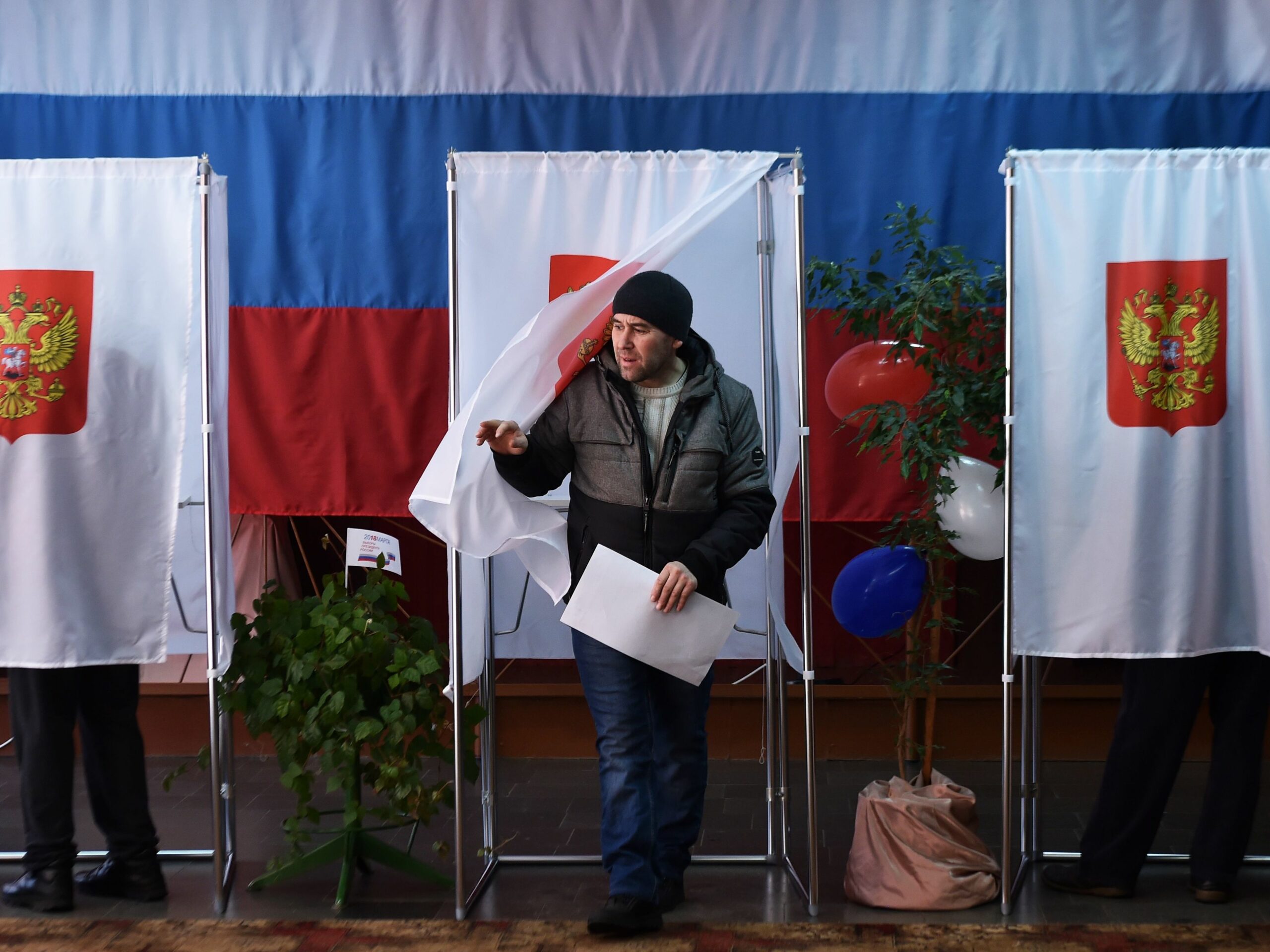
Legislative elections are currently being held in Russia between September 17-19, as 450 new members in the State Duma need to be elected.
The Central Election Commission (CEC) of the Russian Federation decided to open a record number of polling stations in the Transnistrian region – 27 polling stations, in addition to only 3 polling station opened on the right bank of the Dniester in such big cities as Chisinau, Comrat and Balti.
That is the largest number of polling stations opened by the Russian CEC in a foreign country, and five polling stations more than in the 2016 elections. Two of the polling stations were established in Tiraspol, being open from Friday to Sunday. The rest of the Russian polling stations on the Transnistrian territory are opened on Sunday only. The most astonishing fact is that no state other than Russia has ever opened polling stations in the separatist region of the Republic of Moldova. Actually, no polling stations are being opened on the Transnistrian territory when it comes to national elections of the Republic of Moldova either.
Therefore, one could say that the stakes are high when it comes to Transnistrian voters, especially since, most likely, the hopes of Russian authorities are not necessarily based on a large turnout and their real support, rather on the real possibility of electoral fraud on a territory that is not controlled by the constitutional authorities in Chisinau.
Before the presidential elections in 2018, Russian authorities announced that there are 220 thousand Russian citizens living in the Transnistrian region. That time, 24 polling stations were opened in the separatist area. Despite the fact that the Tiraspol Electoral Commission announced that, in the last year and a half alone, the voter turnout has officially fallen in the region by more than 7 700 people, the Russian CEC still decided to establish a record number of polling stations this year, which strengthened the argument about the possibility of election fraud.
Both Tiraspol’s administration and the regional media campaigned for the ruling political party United Russia and called for a high turnout at polling stations. Transnistria’s leader, Vadim Krasnoselski, urged the people on the left bank of the Dniester to come to the polls “because despite all the difficulties, Russia does not forget Transnistria and helps it as much as possible.”
It seems that the campaigning, along with the Russian sponsorship in the region, show great results during every election ballot, as Russian citizens voting in Russian elections in Transnistria are a more active electorate than Moldovan citizens residing in Transnistria and voting in the Moldovan elections at the polling stations arranged on the other bank of the Dniester, especially for them. In the previous Russia’s legislative elections, 56 thousand people voted in Transnistria, while just under 29 thousand inhabitants of the Transnistrian region voted in the recent Moldova’s parliamentary elections.
Before every election ballot held in the Russian Federation, Moldovan authorities make statements, suggesting the Russian side to abstain from opening polling stations in Transnistria, whereas Russian authorities ignore them every time.
This year, the Ministry of Foreign Affairs and European Integration of the Republic of Moldova also sent a note of protest against opening the polling stations in Transnistria. “The Ministry of Foreign Affairs and European Integration regrets that, despite the position consistently expressed by the Moldovan authorities, the Russian side acted in a manner that does not correspond to the principle of sovereignty and territorial integrity of the Republic of Moldova and the bilateral legal framework.”
The Ministry representatives noted that Russian authorities were informed of the lack of impediments to open polling stations in localities under the control of Moldova’s constitutional authorities and requested the Russian side to refrain from opening the 27 polling stations in the localities of the breakaway region, given the impossibility of ensuring the necessary security conditions for the current elections.
Moscow’s Central Election Commission also opened nine polling stations in Abkhazia and ten in South Ossetia – two disputed territories that were internationally recognised by Russia and a few more countries, while considered under military occupation, according to the Georgian Government. These lands, that are under the exclusive control of Russia, offer good opportunities to ‘correct’ any uncomfortable results obtained in the country, where the ruling political party no longer enjoys as much support as it wants to appear.
Photo: wjct.org
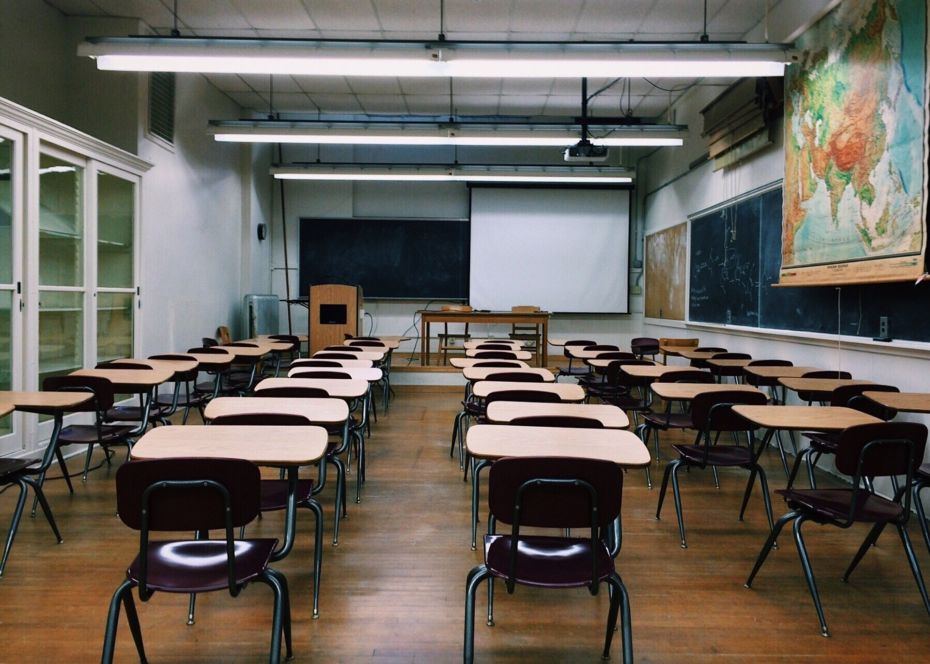
Education institutions in the Transnistrian region resumed their activities on September 1, just as the schools throughout the entire territory of the Republic of Moldova. Once a new academic year began, the old and postponed for 30 years problems of the region came to light again.
There are 8 schools with teaching in Romanian on the Transnistrian territory (5 high schools, 2 secondary schools and a boarding school) that have been persecuted, limited and discriminated since the 90s, when Romanian was declared the official language of the independent Republic of Moldova. Nowadays, the education institutions “face numerous pressures and intimidations from the Tiraspol administration,” Promo-LEX Association alerted.
Such issues as lack of own buildings, the existing ones being not adapted to the education process, the risk of students’ enlisting in the region’s army, and challenges to ensure the free movement of persons and goods are some of the main problems encountered by the Transnistrian schools that teach in Romanian.
Administration of such schools told about the challenges with fighting for the rented space at the beginning of every academic year. Even though buildings get prepared for the education process, rents are paid from the Moldovan Government budget, being ready to receive students in time, Tiraspol authorities still create artificial troubles that put the schools’ activity on hold. For example, a compulsory registration on a Transnistrian online platform is required – an operation that would allow the institutions from Transnistria to bring goods from the right bank of the Dniester or refuel the school buses at gas station located outside the region.
“We are like an exchange currency,” claimed Raisa Padureanu, Deputy Director of Education at “Lucian Blaga” High School in Tiraspol, referring to every conflict situation between Chisinau and Tiraspol. The education institution operates using the study programs developed by the Ministry of Education in Chisinau in order to facilitate the diplomas‘ acknowledgement by the Moldovan authorities. That, on the other hand, complicates the registration process on Transnistrian platforms.
This September, the Transnistrian militia supervised the gatherings on the occasion of celebrating the beginning of the academic year at 2 schools. Moreover, one case of prohibiting to sing the anthem of the Republic of Moldova and to hoist the state flag was registered.
Some students have to go long distances in order to arrive at school, busses not being provided. Promo-LEX Association reported the problem as violation of the right to free movement and education of children on the left bank of the Dniester.
In such cases, the Bureau for Reintegration Policies and the OSCE representatives are contacted for help, informing the mediators and observers of the 5 + 2 negotiation format as well. Officials’ intervention unlocks the educational process for the moment. The issue remains unsolved in the long rung though, as Tiraspol authorities insist on imposing their own rules, remaining a separate region with a unsettled status.
See also: Good laws, bad implementation? What stands in the way of vaccinating education system employees?
Photo: moldova.org

“They are not needy, but they need help”. How Moldovan volunteers try to create a safe environment for the Ukrainian refugees
Reading Time: 3 minutesAt the Government’s ground floor, the phones ring constantly, the laptop screens never reach standby. In one...

#WorldForUkraine – a map that shows the magnitude of the world’s actions against Russian aggression
Reading Time: 2 minutesThe international community and volunteers from all over te world have launched #WorldForUkraine as a platform that...

How is Moldova managing the big influx of Ukrainian refugees? The authorities’ plan, explained
Reading Time: 3 minutesFrom 24th to 28th of February, 71 359 Ukrainian citizens entered the territory of Republic of Moldova....

Russia And Ukraine At The Beginning of 2022
Reading Time: 4 minutesThis opinion piece was written by Dr. Nicholas Dima. Dr. Dima was formerly a Professor of Geography and...


The man raising children on Nistru river
Reading Time: 7 minutesOn the Nistru, near the village of Varnița, a few colored pens with blue dots in the...

The village of the first astronomer in the Republic of Moldova
Reading Time: 5 minutesFrom eight in the morning till noon, every Thursday and Sunday, people lay their merchandise on the...

The prodigal son returns and turns his grandparents’ home in a tourist attraction on Nistru river
Reading Time: 7 minutesOn the road towards the school, a well-maintained rural house catches your eye, yellow stags painted on...

FC Sheriff Tiraspol victory: can national pride go hand in hand with political separatism?
Reading Time: 4 minutesA new football club has earned a leading place in the UEFA Champions League groups and starred...


Study// What is the reaction of authorities to journalistic investigations?
Reading Time: 3 minutes“People expect logical consequences when they see cases of undeclared assets, conflicts of interest, protectionism or proof...


Secretary General of CoE called on Moldova’s state institutions to avoid constitutional crisis. Politicians took it the way they wanted.
Reading Time: 3 minutesAt the beginning of this month, Speaker of Parliament, Zinaida Greceanii, sent a letter to Secretary General...